
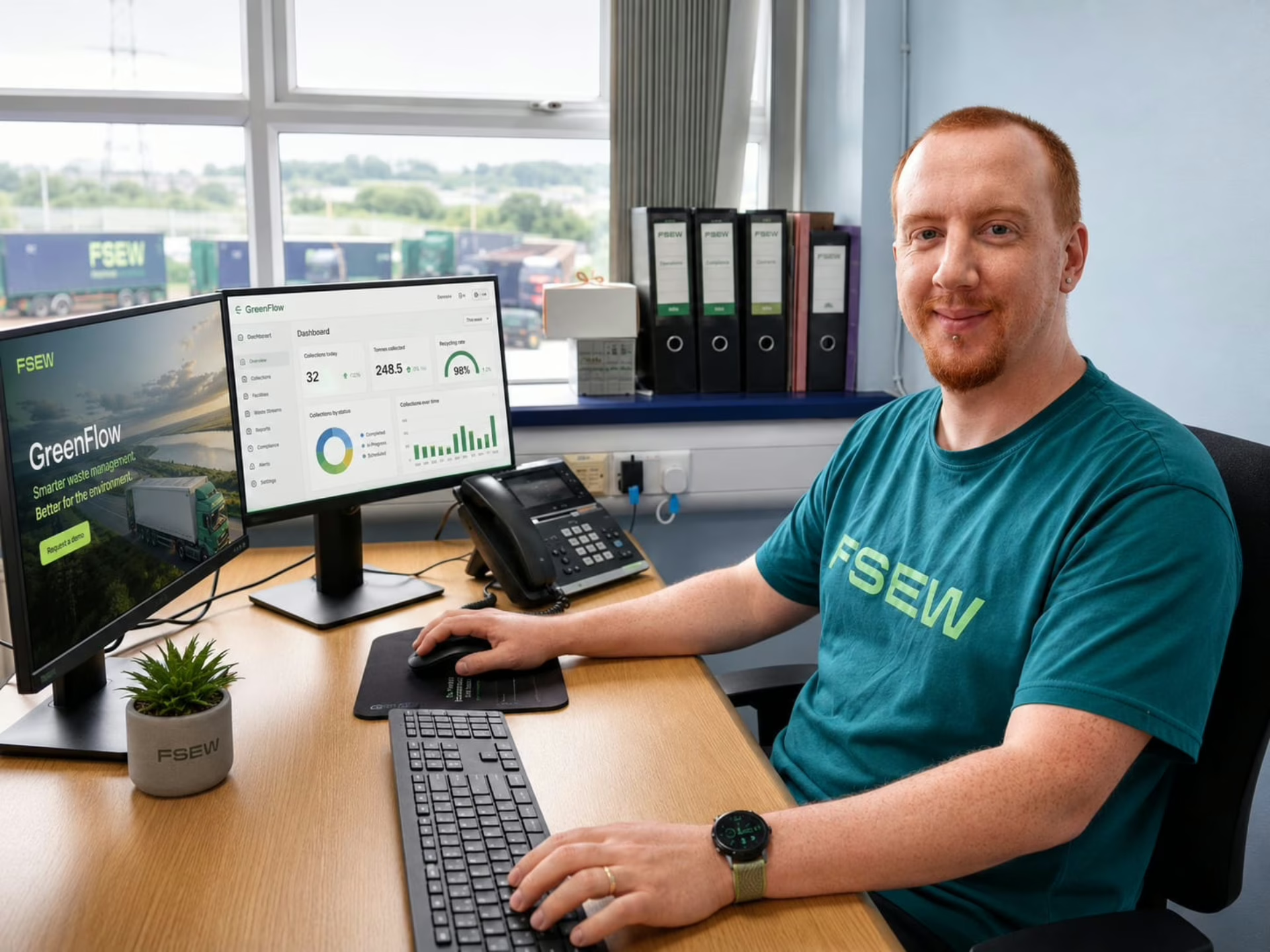
Face of Freight: James Perry
Author

For this Face of Freight interview, we speak to James Perry, Business & Sustainability Analyst at FSEW, about the role data plays in reducing emissions across the supply chain.
At FSEW, sustainability is not treated as a separate ambition from day-to-day logistics; it’s built into the way we plan our routes, measure performance, invest in new technology, and support our customers with clearer carbon reporting.
From Scope 3 reporting and GreenFlow emissions insights to AI-driven forecasting, route optimisation, and FSEW’s journey towards operational Net-Zero, James explains how analysis turns information into action.
1. Everyday Impact
How do you explain what a Business & Sustainability Analyst does to someone who doesn’t work in logistics?
I help businesses understand the environmental impact of their operations and identify practical ways to reduce it. This involves analysing transport and emissions data, interpreting reporting requirements, and turning complex information into clear insights that support decision-making.
Alongside established analysis and reporting, I also work on emerging areas of carbon accounting where methodologies and standards are still evolving. This often involves researching new approaches, interpreting guidance, and helping develop practical reporting solutions for challenges that do not yet have well-established answers. In simple terms, I use data, research, and problem-solving to help businesses better understand and report their emissions.
What does a typical Tuesday look like for you? Are you mostly diving deep into emission spreadsheets, or collaborating across teams?
A typical Tuesday is a mix of analysing transport and emissions data, supporting client projects, researching reporting methodologies, and collaborating with colleagues across the business.
No two days are the same, which is one of the things I enjoy most about the role. I spend a lot of time working with data and supporting sustainability projects, although some colleagues might argue my primary responsibility is making coffee!
FSEW achieved its goal of operating a completely diesel-free fleet ahead of schedule. How did it feel from an analyst’s perspective to see those numbers cross the finish line?
It was incredibly rewarding to see the data reflect what had been achieved operationally. As an analyst, you’re often working behind the scenes measuring progress and tracking performance, so reaching a major milestone like a completely diesel free fleet ahead of schedule was a real validation of the work being done across the organisation. It demonstrated that ambitious sustainability targets can be achieved when they’re supported by strong planning, innovation, and a commitment to delivering real change.
2. Turning Data into the Difference
Logistics emissions (especially Scope 3 supply chain data) are notoriously difficult for businesses to measure. How does your role help clients cut through the noise?
One of the biggest challenges businesses face is understanding how to accurately measure and report their Scope 3 emissions. The data available can vary significantly in quality, detail, and how suitable it is for reporting purposes, which can make it difficult for organisations to understand what their emissions figures are actually telling them.
My role is to help clients understand the data we provide, what it means from a reporting perspective, and how it can be used to support both compliance requirements and operational decision-making. By translating complex emissions data into clear insights, we help businesses understand where emissions are coming from, what actions are likely to have the greatest impact, and how sustainability can be integrated into day-to-day operations.
Can you walk us through how data powers a tool like FSEW GreenFlow? What are clients most surprised to learn when they see their initial emission reports?
Tools like GreenFlow are powered by operational data, including vehicle movements, fuel consumption, distances travelled, and shipment activity. By combining and analysing this information, we can provide businesses with a much clearer picture of the emissions associated with their transport operations. The real value comes from turning that data into actionable insights, allowing organisations to identify opportunities for improvement and track progress over time.
What often surprises clients is the scale and location of their emissions. Many businesses have assumptions about where their biggest impacts lie, but the data can reveal unexpected hotspots within their operations or supply chain. Having that visibility is often the first step towards making informed decisions that deliver both environmental and operational benefits.
We often see cases like the partnership with ROCKWOOL, which used digital twin route mapping to save hundreds of tonnes of CO₂. How crucial is data modelling before an electric or biomethane truck even hits the road?
Data modelling is crucial because it helps us understand where the biggest opportunities for decarbonisation exist before any vehicles are deployed. By analysing real operational data, we can identify the routes that are easiest to transition to low-carbon alternatives, as well as those that may require further infrastructure, technology, or operational changes.
It also allows us to estimate the potential emissions reductions before changes are implemented, helping businesses set realistic expectations and understand the likely environmental benefits of different options. This enables us to identify quick wins, build a roadmap for wider fleet decarbonisation, and ensure that investment is focused where it can deliver the greatest impact.
Rather than taking a one-size-fits-all approach, data modelling helps businesses understand which routes are ready for electric or biomethane vehicles today and which may need a longer-term strategy. It reduces risk, supports informed decision– making, and ensures that sustainability improvements can be delivered practically and cost-effectively.
3. Culture, Innovation & Looking Forward
With FSEW implementing more AI-driven forecasting and route optimisation, how is the toolkit of a sustainability analyst evolving?
FSEW’s use of digital tools and innovative data solutions provides access to a level of operational insight that would have been difficult to achieve just a few years ago. For me, the biggest change has been having access to more detailed and reliable information, which makes analysis more accurate and helps us better understand emissions performance.
The role of a sustainability analyst still centres on interpreting data, understanding reporting requirements, and translating information into meaningful insights. As systems become more advanced and data becomes easier to access, less time can be spent gathering information and more time can be spent understanding what it means and how it can be used to support decision-making.
AI also has the potential to support this process by helping analyse large datasets, automate repetitive tasks, and develop tools that make complex information easier to work with, allowing more time for us to focus on insight and problem-solving.
FSEW’s next major milestone is achieving operational Net-Zero by 2030, alongside opening the UK’s first fully renewable Low Carbon Freight Hub in Cardiff this June. What role will data play in managing a hub powered by its own wind and solar energy?
Data will be essential to ensuring the hub operates as efficiently as possible. As more low-carbon technologies are introduced, data can help optimise charging schedules, understand site energy demand, manage grid capacity, and make better use of available energy resources.
From a sustainability perspective, it also provides the evidence needed to measure performance, understand environmental impact, and track progress towards Net-Zero objectives. By combining operational and sustainability data, we can make informed decisions that improve efficiency while supporting long-term decarbonisation goals.
What is the most rewarding part of doing this work, specifically at FSEW?
The most rewarding part of working at FSEW is the opportunity to tackle new and complex challenges. I enjoy bringing together different sources of data, researching emerging reporting methodologies, and understanding how evolving standards can be applied in practice. Sustainability reporting is developing rapidly, particularly in areas where there is limited precedent, so there is often a need to explore new approaches and solve problems that do not yet have established solutions.
What makes the role particularly rewarding is being able to contribute to projects that are at the forefront of developments in carbon reporting. The combination of research, analysis, and problem-solving keeps the work interesting, and it’s satisfying to help develop approaches that can support businesses as sustainability reporting continues to evolve.
Meet more of the people behind FSEW
James’ work shows how important data, reporting and practical problem-solving are to the future of sustainable freight. Behind every emissions report, route model and decarbonisation project is a whole team working to make lower carbon logistics easier to understand, measure and deliver.
To learn more about the people driving FSEW forward, meet the wider team on our dedicated page. Or, to explore FSEW’s sustainability work in more detail, visit FSEW Sustainability.