
Businesses are under growing pressure to understand the carbon impact of their supply chains, and for companies that move goods regularly, freight is an important part of that picture.
At FSEW, our GreenFlow service helps businesses reduce freight emissions across road, sea, rail and other transport modes, and prove the impact through monthly carbon emissions reports. These reports detail the transport used for your business over the past month and the carbon saved or produced across each part of your freight operation.
Here’s what a full GreenFlow freight carbon report includes, and how it can help your business.
What is carbon reporting in freight?
Carbon reporting is the process of measuring and presenting greenhouse gas emissions data. In freight, it means creating a clear carbon emissions report in specific relation to transport activity.
Our freight carbon emissions reports show:
- How many movements or shipments were completed
- Which vehicle types, fuel types or freight modes were used
- The amount of carbon emissions produced
- The emissions saved compared with diesel freight where a direct road freight comparison applies
- The emissions linked to specific routes, ports, trade lanes or multimodal journeys
Instead of broad claims about sustainable freight, a detailed report gives companies specific numbers that they can use, review and share.
What is carbon reporting in freight?
Carbon reporting is the process of measuring and presenting greenhouse gas emissions data. In freight, it means creating a clear carbon emissions report in specific relation to transport activity.
Our freight carbon emissions reports show:
· How many movements or shipments were completed
· Which vehicle types, fuel types or freight modes were used
· The amount of carbon emissions produced
· The emissions saved compared with diesel freight where a direct road freight comparison applies
· The emissions linked to specific routes, ports, trade lanes or multimodal journeys
Instead of broad claims about sustainable freight, a detailed report gives companies specific numbers that they can use, review and share.
Why is carbon reporting important for businesses?
Customers, suppliers, tender panels and investors increasingly expect evidence of sustainability, and a carbon emissions report allows you to easily prove your reduction. It’s all well and good having a sustainability target, but a report acts as physical evidence that you’re putting in the effort.
This is especially useful for Scope 3 carbon reporting, where transport and distribution can form part of a company’s wider value chain emissions. Regular freight data gives businesses a clearer way to understand the impact of their logistics choices.
What does a GreenFlow carbon emissions report include?
GreenFlow customers receive a monthly carbon emissions report that details the emissions linked to their freight activity, whether that freight moves by road, sea, rail, or a combination of transport modes. For road freight, the report highlights how much less carbon has been produced by using lower-emission GreenFlow transport rather than regular diesel transport. For other modes, it shows the emissions linked to specific routes, trade lanes or shipments.
The report compiles information regarding all modes of transport that your business uses, and is designed so that all members of staff can understand it clearly, regardless of their level of involvement in freight. Within your report, you’ll receive an overview and relevant breakdowns based on the type of freight used:
A breakdown of road freight movements by fuel type
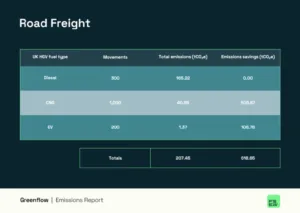
This section of the report shows road freight movements by UK HGV fuel type, including diesel, CNG and EV.
This helps businesses see how much of their freight has moved through lower-emission options, rather than relying only on diesel. It shows exactly how many movements were made using each type of fuel, and the savings in tCO2e (tonnes of carbon dioxide equivalent) for each.
A breakdown of sea freight by route and container
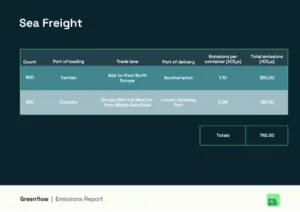
GreenFlow also reports on sea freight, where it forms part of a customer’s supply chain. A sea freight emissions report will include details such as:
· Container count
· Port of loading
· Trade lane
· Port of delivery
· Emissions per container in tCO2e
· Total emissions in tCO2e
For example, a GreenFlow sea freight report could show goods moving from a port in China to a UK port, with emissions calculated per container and in total. This gives businesses a clearer view of the carbon impact of international freight, rather than only seeing the final UK delivery leg.
Total emissions in tCO₂e
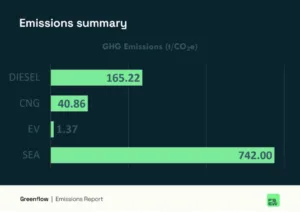
Alongside the savings, the report also presents the emissions data as a simple bar chart. This makes the comparison easy to understand quickly, demonstrating how much emissions are still being created and where to improve.
For sea freight and multimodal freight, total emissions will also be shown by route, shipment, trade lane or transport leg.
What types of freight can GreenFlow report on?
GreenFlow is a multimodal service tailored to the way each customer’s freight actually moves. That could mean following the full journey of sea freight from China, rail into Cardiff, and trucks for the final journey to your site.
Depending on the route and transport used, a GreenFlow carbon emissions report can cover:
· Road freight, including diesel, CNG and EV movements
· Sea freight, including ports, trade lanes, containers and emissions per container
· Rail freight, where it forms part of the wider journey
· Multimodal freight, where different transport legs are combined into one clearer emissions picture
We know how complicated it can be to get a clear understanding of your freight and carbon usage, which is why we compile every detail into one easy-to-use report. With a GreenFlow report, that data, including the international shipment stage, is brought together in a way that’s easier to review and use.
How are the emissions calculated?
FSEW’s carbon emissions calculations follow the GLEC Framework, a globally recognised methodology for measuring freight and logistics emissions. The GLEC Framework is aligned with both the GHG Protocol and ISO 14083, ensuring emissions are calculated using a consistent and transparent approach that follows recognised carbon accounting guidance.
GreenFlow reports are built using real operational data wherever possible, including actual distances travelled, shipment weights and vehicle activity. By using data captured through day-to-day transport operations rather than relying solely on broad industry averages, we can provide a more representative view of freight emissions and carbon performance.
How does GreenFlow reporting support UK carbon reporting requirements?
Many businesses are setting net zero targets, participating in CDP disclosures or aligning with initiatives such as SBTi. As organisations place greater focus on reducing emissions across their value chains, understanding the carbon impact of freight and logistics is becoming increasingly important.
The introduction of UK SRS S2 is also increasing the focus on climate-related disclosures and value chain emissions. For many organisations, freight and transport can represent a significant source of Scope 3 emissions, making accurate reporting an important part of understanding and reducing their overall carbon footprint.
How GreenFlow helps businesses move towards sustainable freight
Sustainable freight transport is about reducing the environmental impact of moving goods while still meeting commercial and operational needs.
GreenFlow supports this by combining tailored freight solutions with clear, accessible emissions reporting across road, sea, rail and multimodal transport. By turning complex transport data into practical carbon insights, GreenFlow helps businesses understand where emissions are being generated and how different freight solutions compare.
For businesses looking to reduce Scope 3 emissions, GreenFlow provides regular reporting and detailed emissions data that can be used to track progress over time, support sustainability reporting requirements and make more informed decisions about their logistics operations.
Access transparent reporting of your freight data and carbon savings GreenFlow gives businesses a practical way to reduce freight emissions and prove the impact through monthly carbon emissions reports.
If you want to understand your current freight emissions, reduce Scope 3 carbon and access clearer data for ESG reporting, tenders and carbon reporting, get in touch with us about GreenFlow today.