
The emissions that you can’t directly control, i.e., your supply chain emissions, can often be the barrier between your business and an effective strategy for true net zero.
We can all agree that net-zero is great thing to aim for as a business, but there’s one part in particular that either slips under the radar or is a complete nuisance to incorporate.
Freight can become the quiet problem child for exactly this reason. It’s operationally essential, commercially visible, and notoriously difficult to evidence. If your net-zero strategy is missing a credible freight plan (and the proof to back it up), you’ll be slower to decarbonisation, but you’ll also accepting an avoidable flaw.
The supply chain problem behind net zero
Net-zero planning often assumes the supply chain will behave like an internal department, but in reality, suppliers report in different formats, with different boundaries, at different frequencies, using different methods.
Freight is a perfect example, because it crosses so many seams. Between having changing routes and service levels, variable load factors, different vehicle types, fuel pathways and more, there’s a lot of content that won’t necessarily slot in easily to your own internal reports and plans.
This inconsistency between methods can create messy outputs that are difficult to blend, and often end up with the dreaded proof gap. From here, net-zero strategies can get stuck. It’s not that nobody’s trying, but the supplier reality often just doesn’t match your business’ reporting narrative.
The net-zero legal risk
Net zero has become a liability topic, primarily due to unsupported claims under new CSRD guidance.
A tender response could become a contractual expectation, or a delivery promise could be repeated by a reseller or retailer. Once those commitments are public, commercial, or reportable, net-zero legal risk increases if you can’t consistently provide the evidence behind it.
The necessity to avoid greenwashing is now a governance requirement, rather than an internal communication guideline. Having a repeatable system for calculating your net-zero goals, including the figures that come from scope 3 external emissions, is the easiest way to support yourself. If you can’t reproduce the number next quarter with the same method, it isn’t a dependable foundation for net-zero commitments.
Greenwashing in logistics is usually a systems failure
Greenwashing in logistics is rarely the result of a deliberately misleading team, but rather a systems problem with an often unavoidable ‘too many cooks’ approach.
In most organisations, these functions are operating in parallel to one another:
- The sustainability team sets targets and reporting requirements
- The procurement team selects suppliers on cost, performance, resilience, and capacity
- The logistics team optimises service levels, routes, and delivery outcomes
- The comms and sales teams translate progress into market-facing language
If nobody owns the end-to-end thread from the initial operational activity to the final defensible claim, your organisation can lack a single, reliable source of truth, and your net-zero strategy may fall victim to accidental greenwashing.
If this sounds familiar to your own processes, you’ll likely recognise these three structural failure patterns:
- Boundary fog
People aren’t aligned on what’s included in a transport number (which legs, which services, which geographies). - Method mix
Different suppliers calculate emissions differently, so comparisons become shaky and year-on-year trends become unreliable. - Audit-trail gaps
The organisation can’t trace a headline figure back to activity data and a documented method.
This supply chain reporting problem may well be setting your net zero strategy back. Every part of the plan needs to be water tight, so how do you strengthen this gap?
How to create a net zero supply chain
If you want to know how to create a net zero supply chain, start with a practical principle: treat supply chain decarbonisation like operational performance, not an independent, one-off reporting exercise. The best way to do this is to integrate sustainable suppliers who share your vision for net-zero, and to build a proof pipeline that can run repeatedly and improve over time.
1) Map your proof exposure
Where do your net-zero commitments show up today? Think beyond the annual report. Include tenders, customer questionnaires, product claims, delivery and returns messaging, supplier scorecards, and internal KPIs.
2) Prioritise what is both material and visible
Scope 3 emissions, for example, have a high impact on your missing supply chain sustainability links. Freight is often both material (it adds up quickly) and visible (it touches customer experience and brand perception). That makes a sustainable freight partner a smart place to start.
3) Set minimum evidence standards for supplier emissions inputs
Your organisation may well be under-specifying what evidence you need from your suppliers, which will be affecting what you’re able to track and/or report.
4) Embed those standards into procurement
If evidence is optional, it won’t arrive consistently. Make the proof pipeline part of your supplier requirements, rather than an additional, nice-to-have request.
5) Create a quarterly rhythm
A net-zero strategy will no doubt become a stressful experience when evidencing it becomes an annual scramble. A quarterly rhythm turns your net-zero decarbonisation plan into a managed process of measure, improve, validate, repeat to keep ambition and credibility moving at the same pace.
Why net zero can’t rely on offsets and assumptions
There’s a reason the market is becoming more sceptical of net-zero narratives that lean heavily on compensation. Without specific numbers to back up the claims, broad ‘net zero’ goals can look like a greenwashing attempt to bring in environmentally-conscious buyers, without doing the heavy lifting of making it true from within the business.
Verifiable decarbonisation means that you’re creating measurable reductions inside your value chain, supported by data you can trace and explain. This goes significantly further when it comes to gaining trust from your client base.
Verifiable decarbonisation in freight
Freight is one of the rare areas where this is achievable without waiting for a breakthrough technology story that will minimise environmental impacts. With the right approach, you can displace diesel and reduce carbon intensity today, as well as produce the evidence for it that holds up in procurement and reporting.
A specialist freight partner can fill the holes in your narrative when it comes to the net zero strategy. If your freight partner is operating genuine low-carbon solutions at scale, and can provide measured inputs through telematics and consistent reporting, you can take those evidenced steps towards true net zero, and communicate this to your client base without worrying about it being a criticisable, vague claim.
Sustainable freight partner checklist: what a net-zero plan should demand from logistics suppliers
Procurement and sustainability teams need specification they can enforce with external suppliers, as this will help fill the gaps in your net zero strategy with concrete proof that your freight partner is helping you to achieve your sustainability goals.
Here’s a sustainable freight partner checklist of things to ask your supplier. Use this to ensure you’re getting a partner who’s invested in your net-zero credibility, on top of service delivery:
- Coverage clarity
What proportion of your volume can they move using low-carbon operations today? Which lanes, which services, which regions? What sits outside scope?
- Data quality transparency
Can the supplier show what is measured versus modelled? Are estimates clearly flagged?
- Method consistency
Will the same approach be used next quarter, and next year? If methodology improves, is there a clear change log so that comparisons continue to be meaningful?
- Traceability
Can outputs be traced to activity inputs (lane-level at minimum, shipment-level where feasible), with documented assumptions?
- Operational reduction pathway
Reporting alone doesn’t cut carbon. A credible sustainable freight partner can show you how their decarbonisation happens operationally.
- Governance fit
Will the supplier provide evidence packs suitable for tenders, reporting, and stakeholder scrutiny?
Greenflow is your missing link
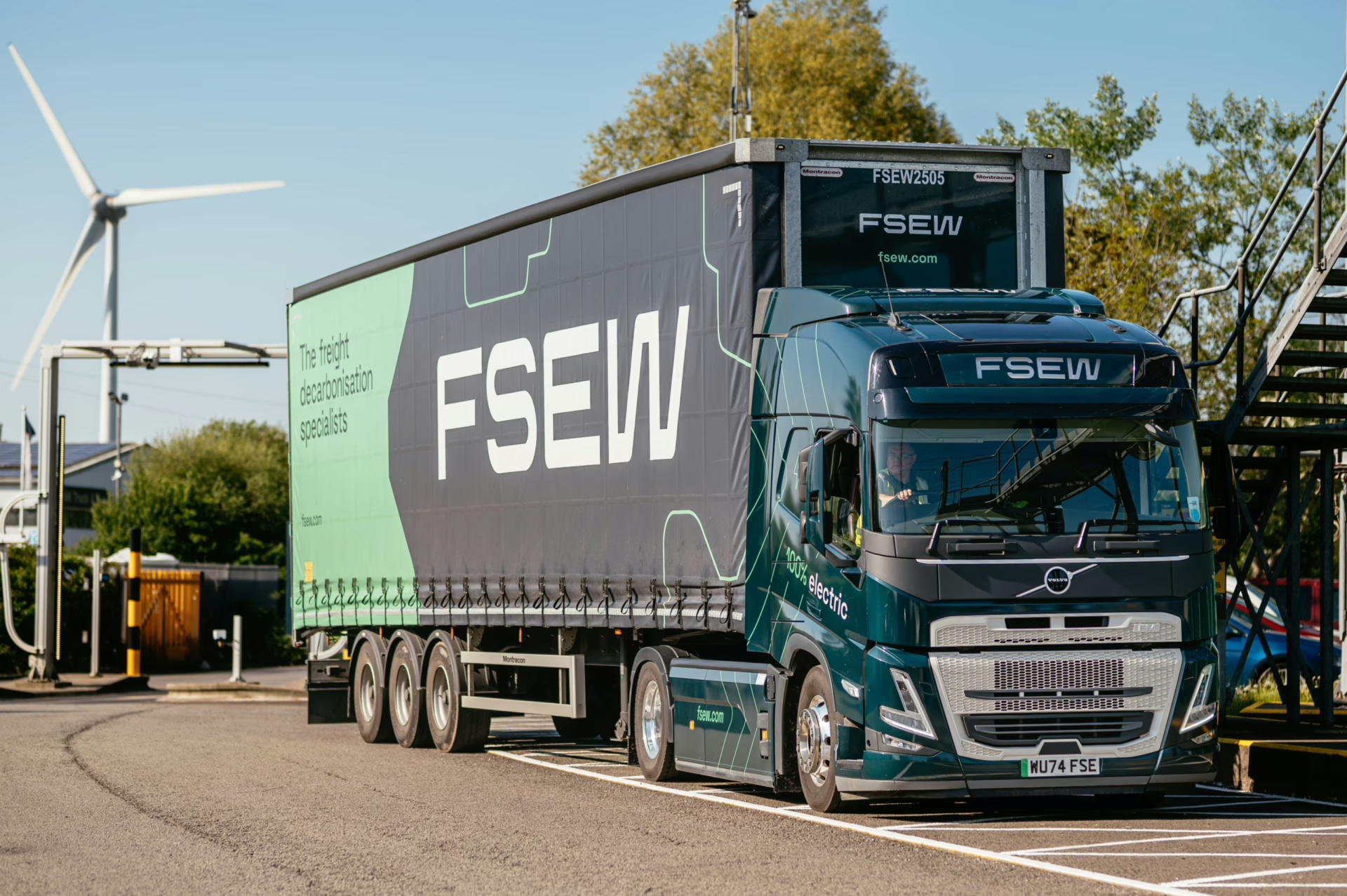
At FSEW, our freight service is above and beyond moving goods. We’re as committed to net zero as you are, which is why we’ve created GreenFlow.
GreenFlow combines operational decarbonisation with ESG reporting that stands up to scrutiny. We focus on includes real-world low-carbon operations (including electric and biomethane solutions where appropriate) and the ability to generate consistent, traceable reporting inputs.
Stop pledging in public what you can’t prove in procurement
If you want a net zero strategy that holds up commercially, legally, and reputationally, start by fixing the evidence gap in the parts of Scope 3 that are measurable and visible using sustainable freight partner.
To reduce your risk of greenwashing and build credible, repeatable net-zero evidence from your logistics activity, explore GreenFlow and see how FSEW turns freight decarbonisation into verifiable results you can stand behind.